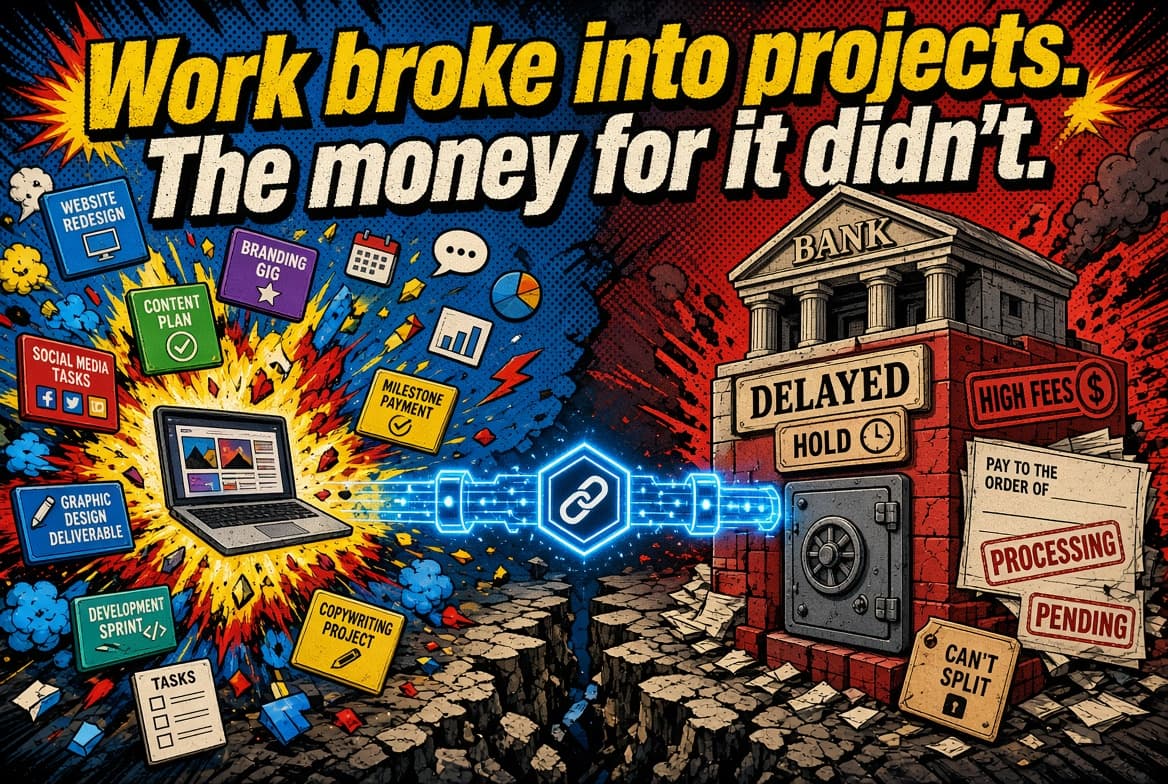
Work broke into projects. The money for it didn't
Three reports from 2025, read side by side, tell one story.
Three reports came out over the course of 2025. Different people wrote them about different things: one about demand for skills, one about who is doing the work, one about how money moves. None of them is about freelance platforms.
But put them side by side and they describe the same shift, just from different angles.
Demand is being rewritten faster than people can retrain
The World Economic Forum surveyed over a thousand large employers - together representing 14 million workers across 22 industries and 55 economies. The horizon is 2030.
The numbers: 170 million jobs will be created, 92 million displaced. Net gain of 78 million. But the interesting figure isn't the net - it's the churn: 22% of all formal jobs in the sample changing places within five years.
The number that matters most is a different one. 39% of the average worker's core skills will change by 2030. Not their job title. The skills inside the same job title.
Demand is growing fastest for three things: AI and big data, networks and cybersecurity, technological literacy. Across the top ten industries, more than 90% of employers expect demand for AI and big data skills to rise.
By growth rate, the three fastest-growing roles are big data specialists, fintech engineers, and AI and machine learning specialists.
And the core skill employers still name first is analytical thinking - seven out of ten companies call it essential. Technology on top, thinking underneath.
That work is increasingly not done by an employee
The second report is MBO Partners, fifteenth annual edition, September 2025. US data.
72.9 million Americans work independently. That didn't happen overnight - it's a ceiling the market has been climbing toward for years, and last year it moved up again.
The structure is more interesting than the total. 5.6 million independents earn over $100,000 a year. That's up 19% in a single year, and 86% since 2020. The segment has nearly doubled in five years.
This breaks the familiar picture of freelancing as something you do between real jobs. The fastest growth is at the top - people who chose to work for themselves because it pays better.