Disputes aren't won by whoever's right - they're won by whoever can show it
Five habits during the work that make a dispute end in a day, or never start at all.
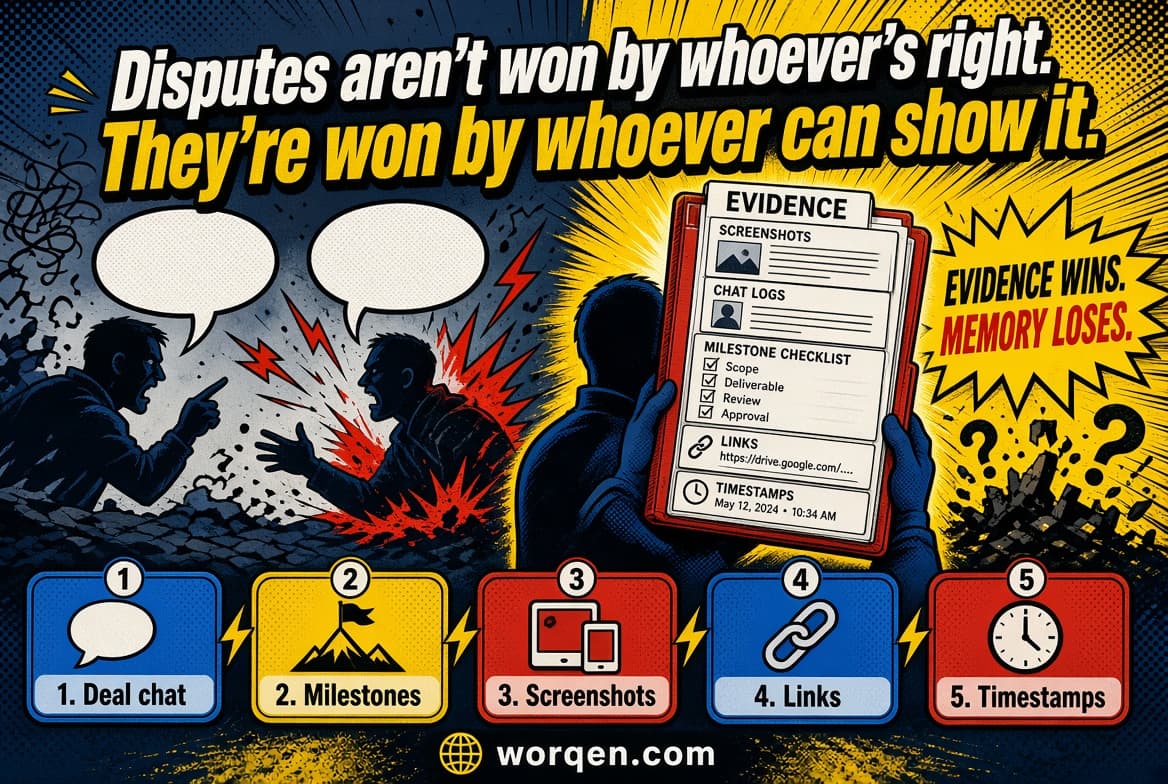
Picture two people in a dispute.
One says: "We agreed on three pages, he delivered one."
The other: "No, we agreed on one, and the rest got added later."
Both are genuinely certain they're right. Both, most likely, really do remember the conversation that way.
And now a third person has to decide - someone who wasn't there for that conversation.
They can't look inside your memory. They can only look at what's left: the job description, the milestones, the deal chat, the attached files. If that's empty, the call gets made close to blind, and at least one of you won't like the outcome. Possibly both.
This article is about making sure that doesn't happen. And the important part: almost every habit here is useful even if you never see a dispute. They just make the work clearer.
The core rule: if it isn't on the platform, it didn't happen
You agreed on a call. You clarified something on Telegram. You sent revisions as a DM somewhere else.
All of that is fine, and nobody expects you to live inside one window. But a dispute review sees what happened on the platform. A conversation that didn't happen here doesn't exist for the review - not because you aren't believed, but because there's nothing to confirm it with.
So the simplest and most useful habit: after a conversation elsewhere, post a short summary into the deal chat.
One message is enough:
"Summarizing our call: three banners instead of two, deadline moves to Wednesday, the amount stays the same. Correct me if I got any of that wrong."
Thirty seconds. And now the agreement has a date, an author, and the other side's confirmation.
The deal chat opens itself - use it from day one
When you apply for a job, a chat between you and the other side appears automatically. That's the primary place your working history lives.
It keeps everything: text, images, voice messages. The history stays put - you can scroll back to the first message.
Which leads to something simple. Don't move the work discussion somewhere else just because it's more convenient there. One day of convenience costs you your evidence in any disagreement - and, honestly, your own memory too: a month from now you won't recall which of five messengers the deadline was agreed in.